Thursday, 15 December 2011
Wednesday, 14 December 2011
Harivansh Rai Bachchan
Harivansh Rai Bachchan, born Harivansh Rai Bachchan Shrivastav, was a noted Hindi poet of Chhayavaad literary movement (romantic upsurge) of early 20th century Hindi literature. He was also a famous poet of Hindi Kavi Sammelan. He is best known for his early work Madhushala. He is also the father of Bollywood megastar, Amitabh Bachchan.
![]() |
| Harivansh Rai Bachchan |
Personal Life
Born in a Srivastava Kayastha family, in the village of Babupatti (Raniganj) in the district of Pratapgarh, U.P. near Allahabad in the United Provinces (modern Uttar Pradesh) he was the eldest son of Pratap Narayan Shrivastav and Saraswati Devi. He was called bachchan (meaning promise at home. He received his formal schooling in a municipal school and followed the family tradition of attending Kayastha Paathshaalas to learn Urdu as the first step to a career in law. He later studied at the Allahabad University and Banaras Hindu University. In this period, he came under the influence of the independence movement, then under the leadership o fMahatma Gandhi.
Education
Realizing that this was not the path he wanted to follow, he went back to the university. However from 1941 to 1952 he taught in the English Department at the Allahabad University and after that he spent the next two years at St Catharine's College, Cambridge, Cambridge University doing his doctoral thesis on W.B. Yeats. It was then, that he used ‘Bachchan’ as his last name instead of Srivastava. Harivanshrai’s thesis got him his PhD at Cambridge. He is the second Indian to get his doctorate in English literature from Cambridge. After returning to India he again took to teaching and also served at All India Radio, Allahabad.
In 1926, at the age of 19, Bachchan married his first wife, Shyama, who was then 14 years old. However she died ten years later in 1936 after a long spell of TB at just 24 years of age. Bachchan again married, Teji Bachchan, in 1941. They had two sons, Amitabh and Ajitabh.
In 1955, Harivanshrai shifted to Delhi to join the External Affairs Ministry as an officer on Special duty and during the period of 10 years that he served he was also associated with the evolution of Hindi as the official language. He also enriched Hindi through his translations of major writings. As a poet is famous for his poem Madhushala (a bar selling alcoholic drinks). Besides Omar Khayyam’s Rubaiyat, he will also be remembered for his Hindi translations of Shakespeare’s Macbeth and Othello and also the Bhagvad Gita. However in Nov 1984 he wrote his last poem ‘Ek November1984’ on Indira Gandhi’s assassination.
Career
From 1941 to 1952 he taught English Literature at Allahabad University and then spent two years at Cambridge University, at St Catharine's College. There he studied with the famous English literature don, Thomas Rice Henn, and received a doctorate in English Literature for his work on the Irish poet W.B. Yeats and Occultism. It was there that he used Bachchan as his last name instead of 'srivastava. He was the second Indian to get his doctorate in English literature from Cambridge University.
After returning to India, he taught briefly and then worked as a producer for All India Radio,mumbai In 1955, he moved to Delhi to join theMinistry of External Affairs of the Government of India and there he was closely involved with the evolution of Hindi as the official language of India.
|
Munir Niazi
MUNIR NIAZI
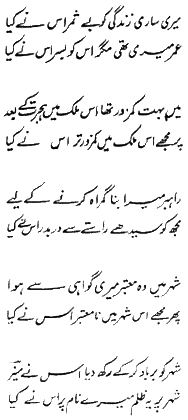
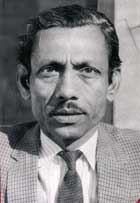
Munir Ahmad, better known as Munir Niazi, was an Urdu poet from Pakistan who also produced poetry in the Panjabi language.
Niazi was born in Khanpur on 19 April 1928, a village near Hoshiarpur, India. He was from the Niazi tribe. He was initially educated at Khanpur and after the partition of India he migrated to newly independent Pakistan and settled in Sahiwal, where he passed his matriculation. He earned an intermediate degree from S.E. College, Bahawalpur and a B.A. from Diyal Singh College in Lahore, Pakistan
Munir Niazi launched a weekly, seven coulors, from Sahiwal in 1949. He wrote numerous songs for films and made his name as the foremost movie song writer of Pakistan. He also wrote for newspapers, magazines and radio. In 1960 he established a publication institute, Al-Misal. He was later associated with Lahore Television and lived in Lahore till his death.
Taiz Hawa Aur Tanha Phool, Jungle mein Dhanak, Dushmanoon Kai Darmiyan Sham and Mah-e-Munir are some of his Urdu publications. In Punjabi he has published Safar di Raat, Char Chup Cheezan and Rasta Dasan Walay Tarey.
His effective imagery conveys pictures in few words. He has experimented with poetic forms and has tried to create a new style, rhythm and diction in Urdu poetry. Innocence, mythology, nostalgia, dreams, eroticism, and romance are some of his most common themes.
Selected English translations of Munir Niazi's poetical works were edited by Suhail Safdar and published in 1996.
Munir Niazi died of respiratory illness on 26 December 2006 in Lahore.
Sunday, 11 December 2011
Nasir Kazmi
Syed Nasir Raza Kazmi, (1925–1972) was a renowned Urdu poet of Pakistan. He was one of the greatest poets of this era, especially in the use of "ista'aaray" and "chhotee beher". Kazmi was born on December 8, 1925 at Ambala in British India.
Education
Kazmi was educated at Ambala, Simla and Lahore. He returned to Ambala in 1945 and started looking after his ancestral land. After the creation of Pakistan in 1947, he came to Lahore.
He did some journalistic work with Auraq-e-Nau as an editor and became editor-in-chief of the magazine Humayun in 1952. Later he was associated with Radio Pakistan, Lahore and other literary publications and organizations.
![]() |
| سید ناصر رضا كاظمی |
Early Career
Nasir Kazmi started his poetic life in 1940 by following the style of Akhtar Sherani and wrote romantic poems and sonnets. Later he began writing ghazals under the guidance of Hafeez Hoshyarpuri. He was a great admirer of Mir Taqi Mir and probably the melancholy and "Ehsaas-e-Mehroomi" in his poetry was a direct result of that. His tutor in poetry was Hafeez Hoshyarpuri, who himself used a lot of symbols from nature in his poems.
Nasir, few days before his death, said in a TV interview by Intezaar Hussain, that
'horse riding, hunting, wandering in a village, walk along the river side, visiting mountains etc. were my favourite pastimes and probably this was the time when my mind got nourishment for loving nature and getting close to the expression of poetry. All my hobbies are related with fine arts, like singing, poetry, hunting, chess, love of birds, love of trees etc... I started poetry because I used to reflect that all the beautiful things those I see, and those in nature are not in my hands, and they go away from me. Few moments, that time which dies, cannot be made alive. I think can be alive in poetry, that is why I (Nasir) started poetry!'
Nowadays, very few people may remember that Nasir used to hum his poetic verses and that humming had much attraction in it. He migrated from Ambala, India to Lahore Pakistan in August 1947. He also worked as a Staff Editor in Radio Pakistan. He used to sit at Tea House and wander at Mall Road, Lahore with his friends. He was fond of eating, wandering and enjoying life. Normally people take him as a sad poet but most of his poetry is based on romantic happiness and the aspect of hope.
His last four books were published after his death. He died in Lahore on March 2, 1972 due to stomach cancer. Few people know that he did some great translations of English poets, especially his translation of Walt Whitman's "Crossing Brooklyn Ferry" by the title of "Brooklyn Ghaat Ke Paar" is a real masterpiece and worth reading.
Books
- Barg-e-Nae (1952)
- Deewaan (1972)
- Pehli Baarish (1975)
- Sur Ki Chhaya (Manzoom Drama, Katha 1981)
- Khushk Chashme ke Kinare (Prose, 1982 edited by Basir Sultan Kazmi & Hassan Sultan Kazmi, New Edition 1990, essays, radio features, dialogues, editorials, last interview etc.)
- Nasir Kazmi Ki Dairy (Chand Pareshan Kaghaz) (Autobiography, 1995 compiled by Hassan Sultan Kazmi)
- Intekhab-e-Meer (poetry 1989)
- Intekhab-e-Nazeer (poetry 1990)
- Intekhab-e-Wali Dakni (poetry 1991)
- Intekhab-e-Insha (poetry 1991)
- 'Intekhabs' of other poets
Famous Ghazals & Nazms
Some of the famous ghazals and nazams of Nasir Kazmi are listed below,
- kaun is raah se guzartaa hai
- terii zulfoN ke bikharne kaa sabab hai ko'ii
- dukh kii lehar ne chheRaa hogaa
- dil meN ek lehar sii uThii hai abhii
- naaz-e-be-gaangii meN kyaa kuch thaa
- O ! mere masruuf Khudaa
- yaas meN jab kabhii aaNsuu niklaa
- ko'ii jiye yaa ko'ii mare
- be minnat-e-Khizr-e-raah rahnaa
- jurm-e-inkaar kii sazaa hii de
- jab raat gaye tiri yaad aayii, sau tareh se jii ko behlaaya
- tere aane kaa dhokaa saa rahaa hai
- tanhaa ishq ke khwaab na bun
- fikr-e-taameer-e-aashiaN bhi hai
- rang barsaat ne bhare kuch to
- kise dekhein kahaaN dekha na jaye
- karta use beqarar kuch der
- wo dil nawaz hai lekin nazar shanaas nahi
- Neeyat e shauq bhar na jaye kahiin
Subscribe to:
Posts (Atom)