Wednesday, 7 December 2011

Mirza Ghalib


Mirza Asadullah Baig Khan, pen-name Ghalib, ġhālib means dominant) and (former pen-name) Asad, asad means lion) (27 December 1797 – 15 February 1869), was a classical Urdu and Persian poet from India during British colonial rule. During his lifetime the Mughals were eclipsed and displaced by the British and finally deposed following the defeat of the Indian rebellion of 1857, events that he wrote of. Most notably, he wrote several ghazals during his life, which have since been interpreted and sung in many different ways by different people. He is considered, in South Asia, to be one of the most popular and influential poets of the Urdu language. Ghalib today remains popular not only in India and Pakistan but also amongst diaspora communities around the world.


مرزا اسد اللہ بیگ خان


Early Life

Mirza Ghalib was born in Agra into a family descended from Aibak Turks who moved to Samarkand after the downfall of the Seljuk kings. His paternal grandfather, Mirza Qoqan Baig Khan was a Saljuq Turk who had immigrated to India from Samarkand (now in Uzbekistan) during the reign of Ahmad Shah (1748–54). He worked at Lahore, Delhi and Jaipur, was awarded the subdistrict of Pahasu (Bulandshahr, UP) and finally settled in Agra, UP, India. He had 4 sons and 3 daughters. Mirza Abdullah Baig Khan and Mirza Nasrullah Baig Khan were two of his sons. Mirza Abdullah Baig Khan (Ghalib's father) got married to Izzat-ut-Nisa Begum, and then lived at the house of his father in law. He was employed first by the Nawab of Lucknow and then the Nizam of Hyderabad, Deccan. He died in a battle in 1803 in Alwar and was buried at Rajgarh (Alwar, Rajasthan). Then Ghalib was a little over 5 years of age. He was raised first by his Uncle Mirza Nasrullah Baig Khan. Mirza Nasrullah Baig Khan (Ghalib's uncle) started taking care of the three orphaned children. He was the governor of Agra under the Marathas. The British appointed him an officer of 400 cavalrymen, fixed his salary at Rs.1700.00 month, and awarded him 2 parganas in Mathura (UP, India). When he died in 1806, the British took away the parganas and fixed his pension as Rs. 10,000 per year, linked to the state of Firozepur Jhirka (Mewat, Haryana). The Nawab of Ferozepur Jhirka reduced the pension to Rs. 3000 per year. Ghalib's share was Rs. 62.50 / month. Ghalib was married at age 13 to Umrao Begum, daughter of Nawab Ilahi Bakhsh (brother of the Nawab of Ferozepur Jhirka). He soon moved to Delhi, along with his younger brother, Mirza Yousuf Khan, who had developed schizophrenia at a young age and later died in Delhi during the chaos of 1857.
In accordance with upper class Muslim tradition, he had an arranged marriage at the age of 13, but none of his seven children survived beyond infancy. After his marriage he settled in Delhi. In one of his letters he describes his marriage as the second imprisonment after the initial confinement that was life itself. The idea that life is one continuous painful struggle which can end only when life itself ends, is a recurring theme in his poetry. One of his couplets puts it in a nutshell.


قید حیات و بند غم ، اصل میں دونوں ایک ہیں
موت سے پہلے آدمی غم سے نجات پائے کیوں؟

Translation
The prison of life and the bondage of grief are one and the same
Before the onset of death, how can man expect to be free of grief?


Royal Titles 

In 1850, Emperor Bahadur Shah Zafar II revived upon Mirza Ghalib the title of "Dabeer-ul-Mulk". The Emperor also added to it the additional title of Najm-ud-daulah. The conferment of these titles was symbolic of Mirza Ghalib’s incorporation into the nobility of Delhi. He also received the title of 'Mirza Nosha' by the emperor, thus adding Mirza as his first name. He was also an important courtier of the royal court of the Emperor. As the Emperor was himself a poet, Mirza Ghalib was appointed as his poet tutor in 1854. He was also appointed as tutor of Prince Fakhr-ud Din Mirza, eldest son of Bahadur Shah II,(d. 10 July 1856). He was also appointed by the Emperor as the royal historian of Mughal Court.
Being a member of declining Mughal nobility and old landed aristocracy, he never worked for a livelihood, lived on either royal patronage of Mughal Emperors, credit or the generosity of his friends. His fame came to him posthumously. He had himself remarked during his lifetime that although his age had ignored his greatness, it would be recognized by later generations. After the decline of Mughal Empire and rise of British Raj, despite his many attempts, Ghalib could never get the full pension restored.


Views on Hindustan

In his poem "Chirag-i-Dair" (Temple lamps) which was composed during his trip to Benaras during the spring of 1827, Ghalib mused about the land of Hindustan (the Indian subcontinent) and how Qiyamah (Doomsday) has failed to arrive, in spite of the numerous conflicts plaguing it.


Said I one night to a pristine seer
(Who knew the secrets of whirling time)
"Sir, you well perceive
That goodness and faith,
Fidelity and love
Have all departed from this sorry land
Father and son are at each other's throat;
Brother fights brother, Unity and federation are undermined
Despite all these ominous signs,
Why has not Doomsday come?
Who holds the reins of the Final Catastrophe?
The hoary old man of lucent ken
Pointed towards Kashi and gently smiled
"The Architect", he said, "is fond of this edifice
Because of which there is color in life; He
Would not like it to perish and fall."


Tuesday, 6 December 2011

Mir Taqi Mir


Mir Taqi Mir

Mir Taqi Mir  (born 1723 - died September 21, 1810), whose real name was Muhammad Taqi and takhallus (pen name) was Mir (sometimes also spelt as Meer Taqi Meer), was the leading Urdu poet of the 18th century, and one of the pioneers who gave shape to the Urdu language itself. He was one of the principal poets of the Delhi School of the Urdu ghazal and remains arguably the foremost name in Urdu poetry often remembered as Khuda-e-sukhan (god of poetry).


Muhammad Taqi  میر تقی میر

Born in Agra, India (then called Akbarabad), ruled by the Mughals at the time. He left for Delhi, at the age of 11, following his father's death. His philosophy of life was formed primarily by his father, whose emphasis on the importance of love and the value of compassion remained with him throughout his life and imbued his poetry. At Delhi, he finished his education and joined a group of nobility as a courtier-poet. He lived much of his life in Mughal Delhi. Kuchha Chelan, located in famous grain market Khari Baoli, in Old Delhi was his address at that time. However, after Ahmad Shah Abdali's sack of Delhi each year starting 1748, he eventually moved to the court of Asaf-ud-Daulah in Lucknow, at the king's invitation. Distressed to witness the plundering of his beloved Delhi, he gave vent to his feelings through some of his couplets.
Mir migrated to Lucknow in 1782 and remained there for the remainder of his life. He died, of a purgative overdose, on Friday, 21 September 1810. The marker of his burial place was removed in modern times when a railway was built over his grave.


کیا بود و باش پوچھے ہو پورب کے ساکنو 
ہم کو غریب جان کے ہنس ہنس پکار کے
دلّی جو ایک شہر تھا عالم میں انتخاب
رہتے تھے منتخب ہی جہاں روزگار کے
جس کو فلک نے لوٹ کے ویران کر دیا
ہم رہنے والے ہیں اسی اجڑے دیار کے


Baba Bulleh Shah

  
Baba Bulleh Shah
Bulleh Shah (1680–1757) (Punjabi: بلہے شاہ, ਬੁੱਲ੍ਹੇ ਸ਼ਾਹ, Hindi: बुल्ले शाह, full name Abdullah Shah) was a Punjabi Sufi poet, a humanist and philosopher.


Bulleh Shah

Bulleh Shah is believed to have been born in 1680, in the small village of Uch, Bahawalpur, Punjab, in present day Pakistan. His father, Shah Muhammad Darwaish, was a teacher and preacher in a village mosque. Little is known about Bulleh Shah's ancestry except that some of his forebears were migrants from Uzbekistan and that his family claimed direct descent from the prophet Muhammad.
When he was six months old, his parents relocated to Malakwal. His father later got a job in Pandoke, about 50 miles southeast of Kasur. Bulleh Shah received his early schooling in Pandoke and moved to Kasur for higher education. He also received education from Maulana Mohiyuddin. His spiritual teacher was the Qadiri Sufi Shah Inayat Qadiri, who was a member of the Arain tribe of Lahore.


Poetry Style

The verse form Bulleh Shah primarily employed is called the Kafi, a style of Punjabi, Sindhi and Siraiki poetry used not only by the Sufis of Sindh and Punjab, but also by Sikh gurus.
Bulleh Shah’s poetry and philosophy strongly criticizes the Islamic religious orthodoxy of his day.


He died in 1757, and his tomb is located in Kasur, present day Pakistan.


Monday, 5 December 2011

Allama Muhammad Iqbal

The Best of  Allama Iqbal
Allama Muhammad Iqbal Biography
 
Sir Muhammad Iqbal commonly referred to as Allama Iqbal‎, Allama literally Scholar), was a poet and philosopher born in Sialkot, then in the Punjab Province of British India, now in Pakistan. Iqbal, who wrote poetry in the Urdu and Persian languages, is considered to be one of the greatest icons in modern era.
After studying in England and Germany, Iqbal established a law practice, but concentrated primarily on writing scholarly works on politics, economics, history, philosophy and religion. He is best known for his poetic works, including Asrar-e-Khudi—which brought a knighthood— Rumuz-e-Bekhudi, and the Bang-e-Dara, with its enduring patriotic song Tarana-e-Hind. In Afghanistan and Iran, where he is known as Iqbāl-e Lāhorī Iqbal of Lahore), he is highly regarded for his Persian works.
Iqbal was a strong proponent of the political and spiritual revival of Islamic civilization across the world, but specifically in India; a series of famous lectures he delivered to this effect were published as The Reconstruction of Religious Thought in Islam. One of the most prominent leaders of the All-India Muslim League, Iqbal encouraged the creation of a "state in northwestern India for Indian Muslims" in his 1930 presidential address. Iqbal encouraged and worked closely with Muhammad Ali Jinnah, and he is known as Muffakir-e-Pakistan ("The Thinker of Pakistan"), Shair-e-Mashriq ("The Poet of the East"), and Hakeem-ul-Ummat ("The Sage of the Ummah"). He is officially recognised as the "national poet" in Pakistan. The anniversary of his birth on November 9 is a holiday in Pakistan.

Sunday, 4 December 2011

Main Shayer Hoon


٠•●♥ My Sweet Poetry ♥●•٠


Main Shayer Hoon
Toa Aksar Laog Mujh Se Poochtay Hain
Is Haseen Israar Kay Baray main
Batain Toa Bhala Kiya Hai…?
Muhabbat Akhirish Hai Kiyaa…..?”
Wasi Main Hans Kay Kehta Hoon
Kisi Piyasay Ko Apnay Hissay Ka Pani Pilana Bhi..
Muhabbat Hai!
Bahnwar Mai Doobtay Ko Sahil Tak Lai Kay Jana Bhi..
Muhabbat Hai!
Kisi Kay Wastay Nanhi Si Qurbani..
Muhabbat Hai!
Kaheen Hum Raaz Saray Khoal Saktay Hoan Magar Phir Bhi,
Kisi Ki Babasi Ko Daikh Ker Khamosh Hojana Bhi…
Muhabbat Hai!
Ho Dil Mai Dard, Veraani Magar Phir Bhi
Kisi Kay Wastay Jabran Hi Hoantaon Pe Hansi Lanaa
Zabardasti Hi Muskana…
Muhabbat Hai!
Kaheen Barish Mai Sehmay, Bheegtay Billi Kay Bachay Ko
Zara Si Dair Ko Ghar Lai Kay Anaa Bhi
Muhabbat Hai!
Koi Chirya Jo Kamray Mai Bhatakti Aan Nikli Ho
Toa Us Chirya Ko
Pankhaa Band Kar Kay Rastaa Bahir Ka Dikhlana
Muhabbat Hai!
Kisi Kay Zakham Sehlanaa
Kisi Rotayhuay Dil Ko Behlana..
Muhabbat Hai!
Kay Metha Boal, Methi Baat, Methay Lafz, Sab Kiya Hhai?
Muhabbat Hai!
Muhabbat Aik Hi Bas Aik Hi Insaan Ki Khatir
Magan Rehna
Hama Waqt Uski Bataon, Khushboan Mai,
Dolna Kab Hai
Muhabbat Sirf Uski Zulf Kay Bal Kholnaa
Kab hai..
Muhabbat Kay Hazaroan Rang
Laakhoan Istaa’ray Hain
Kisi Bhi Rang Mai Ho Ye
Mujhay Apna Banati Hai
Ye Meray Dil Ko Bhaati Hai!

٠•●♥ My Sweet Poetry ♥●•٠


Teri Ankhun K Haseen Jaal Me Aa Jaon Ga Mai,


٠•●♥ My Sweet Poetry ♥●•٠


Teri Ankhun K Haseen Jaal Me Aa Jaon Ga Mai,
Mujh Ko Lagta Hai Teri Chaal Me Aa Jao Ga Mai.

Zindagi Baad Tere Hona Thi Mushkil Lekin,
Ye Na Socha Tha K Is Haal Me Aa Jao Ga Mai.

[ "Dekh Kr Us Ko Mujhe Yaad Kre Gi Dunya,
Eik Din Us K Khadokhaal Me Aa Jao Ga Mai." ]

Kitne Mosam The Jo De Kr Mujhe Taaney Guzrey,
Tum To Kehte They K Ik Saal Me Aa Jaon Ga Mai.

Sur Me Aa Jaye Ga Jewan Tere Jane Se,
Tere Aane Se Kisi Taal Me Aa Jao Ga Mai

٠•●♥ My Sweet Poetry ♥●•٠


Abi to ishq me aisa b haal hona ha


٠•●♥ My Sweet Poetry ♥●•٠


Abi to ishq me aisa b haal hona ha
K ashk rokna b tm se mahaal hona ha

Tmain khber ha nae tum to lot jao gy
Tmhary hijer me lmha be saal hona ha

Humari roh py jeb be azaab utrain gy
Tmhari yadon ko es dil ke dhaal hona ha

Milain ge hmko be apny naseeb ke khushian
Bus entazar ha k kb ye kmaal hona ha

Her ek shekhs chaly ga hmari rahoon per
Mohabbton me hmain wo misaal hona ha

WASI mjh ko yaqeen ha k wo lot aye ga
Ussy be apny be kiye ka mlaal hona ha!

٠•●♥ My Sweet Poetry ♥●•٠


Eik Masoom Takaddus Me Bhigoya Huwa Lams,


Eik Masoom Takaddus Me Bhigoya Huwa Lams,
Kitna Pakiza Hay Ehsas Me Dhoya Huwa Lams.

Ye Tere Jism Ki Khushbu Ka Sonehra Ehsas,
Jis Terha Chand K Haaley Me Paroya Huwa Lams.

Us K Hontoon Ko Me Chhu Loon To Gumaan Hota Hay,
Jese Jannat K Gulaboon Me Daboya Huwa Lams.

Jo Meri Rooh Me Utrey He Chale Jaate Ho,
Ik Nae Rang Me Ubhrey Ga Ye Boya Huwa Lams.

Bhegi Khusbo Mae Basa, Wasl Me Bhega Bhega,
Kitna Masoom Hay Pehlo Me Ye Soya Huwa Lams.

Tishnagi Aan Basi Hay Meri Pooroon Me WASI,
Dhondta Phirta Hun Muddat Se Main Khoya Huwa Lams.

By WASI SHAH


٠•●♥ My Sweet Poetry ♥●•٠


Ab k Tajdeed e wafa


A beautiful poem by Ahmed Faraz.

٠•●♥ My Sweet Poetry ♥●•٠

Adhi Raat k Shahyied sapnay jhotay they


٠•●♥ My Sweet Poetry ♥●•٠


Chalay bhi ao.....


٠•●♥ My Sweet Poetry ♥●•٠

Teri Umeed tera intazar jab say hay


A beautiful poem by Faiz Ahmend Faiz

Tum meri ankho ka taver na bhula pao gay


٠•●♥ My Sweet Poetry ♥●•٠


Phiray ga to bhi yuhni ku baku hamari tarah


٠•●♥ My Sweet Poetry ♥●•٠

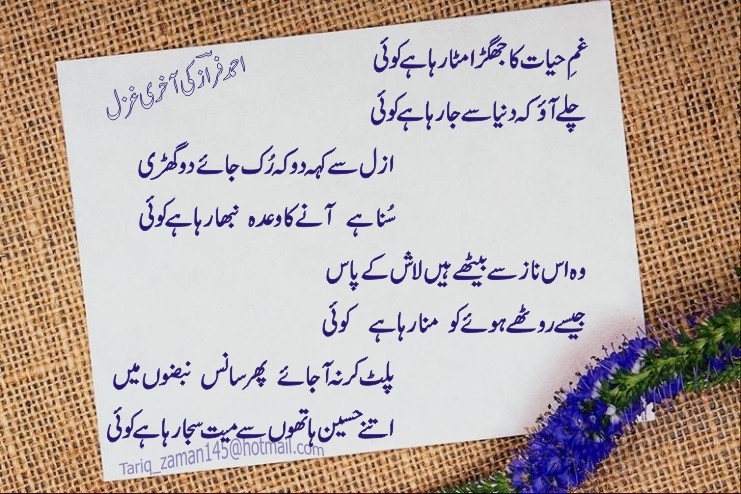
Gham e Hayat ka Jaghra mita raha hay koi


This was last poetry by Ahmad Faraz before his death.

٠•●♥ My Sweet Poetry ♥●•٠
Related Posts Plugin for WordPress, Blogger...